Texas Investment Network


Pitching Help Desk


Testimonials

"For those of you that are asking yourself whether this site is real, the answer is yes. My first thought was that I would put my proposal on the site and it would be sent for review, and at this point someone from within the Dealflow Investment Network office would contact me as an investor so I would be more likely to pay the $249 fee. I received 8 responses from investors overnight and 2 more since then. Thanks Dealflow Investment Network."
David Kriedeman - Chris Christopherson Inc

 BLOG >> February 2026

Ad Development Using Habit Loop Diagrams [Entrepreneurship
Posted on February 20, 2026 @ 11:35:00 AM by Paul Meagher

The new year is often a time to think about acquiring new habits and getting rid of old habits. Before finalizing any resolutions, I thought it might be better to first read some books on habit formation to help improve the odds of successful habit change.

The most popular recent book on habit formation is Atomic Habits: An Easy & Proven Way to Build Good Habits & Break Bad Ones (2018) by James Clear. Before Atomic Habits came out, the most popular book on habit formation was The Power of Habit: Why We Do What We Do In Life And Business (2012) by Charles Duhigg.

I decided to start my reading on habit formation with Charles Duhigg's Power of Habit book.

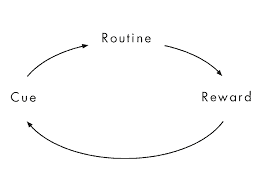
One of the main contributions of the Power of Habits book was to popularize the idea of the Habit Loop concept with this diagram:
One difference between the Power of Habits and Atomic Habits book is that the Power of Habits applies the habit loop concept to understanding and solving business problems whereas Atomic Habits is more focused on applying the habit loop to self improvement. Atomic Habits is more likely to appear in the self-help section of a bookstore, Power of Habits in the business books section.

In this blog, I want to focus on one business problem Duhigg applies the habit loop concept to: advertising a product or service.

In the habit loop diagram above, the idea is that a cue triggers a routine that results in a reward. The reward reinforces the association between habit loop components. When developing an ad for a product or service, one approach is to imagine a habit loop the product or service might play a role in. If you are selling tooth paste, that means defining the cue (or trigger) that makes people engage in the routine of brushing their teeth (e.g., a film on their teeth, going to bed, waking up, finishing a meal, etc...), and the reward that the customer will experience if they use product or service (e.g., improved smile, white teeth, better health, etc..). The advertisement would consist of showing people a cue that triggers the use of your product or service and the reward they will get if they use your product or service (as part of the routine that delivers the reward). If your ad is successful in conveying a habit loop that resonates with the customer, it could lead the customer to purchasing your product or service. If the cue occurs quite frequently in the course of their day then even better as there are more opportunities to sell your product or service to them. For example, if the cue for brushing your teeth is when you finish a meal, and the reward is fresh breath, then there are lots of opportunities for the customer to use your product and hopefully become a regular consumer of your product. A recurring customer for a product or service is the ideal.

Here we see how the concept of a habit loop can be used to guide us in our advertising efforts. The job of the advertiser is to identify the cue for using your product or service and the reward the customer will obtain when they use your product or service. The cue or the reward may not be obvious. Duhigg discusses how Proctor and Gamble employed an advertising team to come up with the best approach to selling a new product they developed: Fabreze. They originally thought the cue was a bad smell, the routine was spraying the thing causing the bad smell with Fabreze, and the reward was the elimination of the odor. Turns out that conveying that story in their advertising didn't sell very well. They eventually discovered that a better habit loop showed the cue of cleaning your home, the routine was a cleaning action that ended with using their product on the cleaned item, and the reward was a cleaned area that not only looked good but smelled good. The ad team only came up with this cue, routine, reward story because they were visiting people who they gave the product to and were using it, and discovered a person who liked to spray cleaned items with Fabreze because it increased the perceived reward of her cleaning efforts (looks and smells great).

The grandfather of advertising, Claude Hopkins (1866-1932), launched many successful brands. Duhigg discusses his success in launching Pepsodent tooth paste. When creating ads for Pepsodent he did alot of research to identify the best cue and reward for his client's Pepsodent tooth paste product. His success in making Pepsodent a brand leader in tooth paste suggests that the simple 3 stage habit loop framework above can be used to help guide ad development.

Duhigg complicates the habit loop story by pointing out that craving often preceeds the routine and motivates people to engage in the behavioral routine that will deliver the reward. After associating a cue with a reward, our brain starts to anticipate the reward and brain activity that used to be associated with the reward occurs before the reward is achieved. This brain activity can be interpreted as craving the reward. Duhigg views craving as "driving" the loop - it appears as embedded in the middle of the loop. James Clear views "craving" as a stage (stage 2) that falls between the cue (stage 1) and the routine (stage 3) which motivates a person to engage the routine. The reward is Stage 4 in Clear's framework. The diagram below uses the example of coffee drinking to convey Clear's 4 stage habit loop.
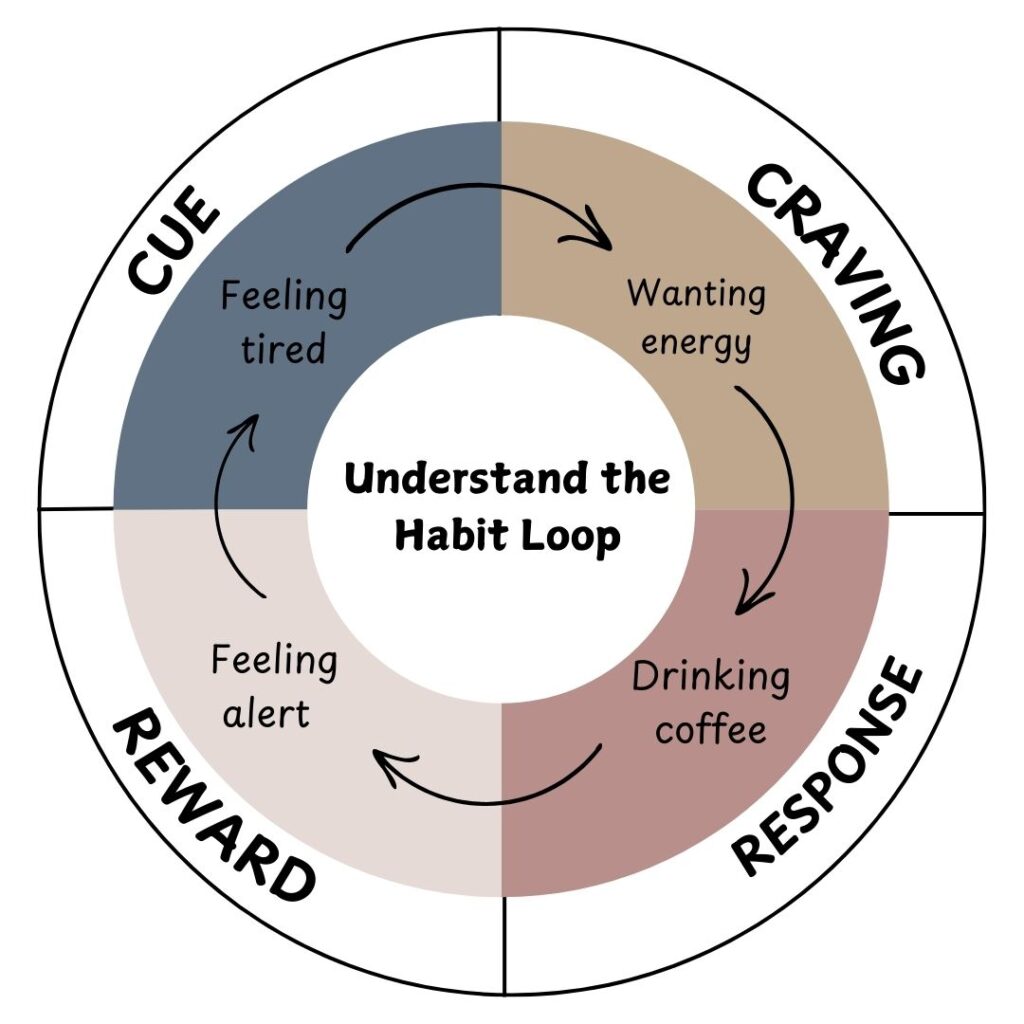

Source: https://readtraverse.com/atomic-habits-summary

One approach to creating an advertisement, might be to create a habit loop diagram for the product or service you want to sell that is similar to the coffee habit loop diagram which has short descriptions for each stage. Once you feel comfortable with the descriptions for habit loop stages, you can proceed to develop an ad that incorporates this habit loop information.

Advertising is not my area of expertise. Many people develop ads without having any theoretical approach guiding them. I don't know if different approaches to ad development produce better results than others. What impressed me about the Habit Loop approach is that it gives you fairly clear guidance on the type of research you might want to do before creating an ad: figuring out how your product or service fits into a habit loop diagram as a first step and then using that habit loop diagram to help you develop the ad.

Permalink 

The History of Energy [Energy
Posted on February 13, 2026 @ 11:32:00 AM by Paul Meagher

Jean-Baptiste Fressoz is the author of the book More and More and More: An All-Consuming History of Energy, 2024.

The importance of the book lies in its forceful argument for a particular pattern in energy consumption throughout history. The standard history suggests that we have advanced through different ages during which particular primary energy sources became dominant. A common progression is the age of wood, the age of coal, the age of oil, and now the nuclear / renewable age. The alternative view that Fressoz advances is that the consumption of each primary energy source tends to increase over time because of the symbiotic relationship between energy sources.

The first chapter of this book is titled "A Symbiotic History of Energy" which refers to the idea that "all primary energies have grown together and have accumulated without replacing each other. Instead of considering energies as separate entities in competition with each other, it reveals the history of their entanglement and interdependence "(p. 1).

The rest of the book documents examples of the ways in which a primary energy sources spurs the increased use of another primary energy source. For example, as we produced more coal we required a large amount of wood for "pit props" to stabilize the mining shafts. Coal that was consumed to power train steam engines required a large amount of wood to build the sleepers that train rails rest upon. Fressoz documents how pit props and sleepers created a huge demand for wood over and above the use of wood for construction and heat.

Fressoz suggest that a more accurate view of history sees us as using more and more and more of each primary source because of the symbiotic relationships between primary energy sources. This goes against a common narrative in the history of energy use that we are undergoing a transition from some more primitive form of energy to some more advanced form of energy. Proponents argue that if we make this transition we will solve some major societal problem. There are probably examples of this, but Fressoz would argue that history suggests consumption of the more "primitive" primary energy source will also continue to grow over time, not be replaced by the more "advanced" primary energy source.

The book teaches us to engage in two habits of thought when we are assimilating information about primary energy flows:

  1. Be skeptical of narratives that suggest we are going through an energy transition. China is bringing a huge amount of renewable energy online each year and some might call them green for doing so, but at the same time they are also bringing a huge amount of coal power online. Reasons for needing additional coal plants is to backstop renewable energy (when the wind isn't blowing and the sun isn't shining) and because coal powered turbines create inertia that helps to increase grid reliability.

    Fressoz offers another reason the use of coal is increasing in China:

    Considered as a 'green technology', the electric car is above all a matter of energy sovereignty in China: half of the world's EVs are in China, where two-thirds of electricity is produced from coal. For the time being, the electric car has had the effect of increasing coals' share in global mobility compared with oil. Orwell's comment is as true today as it was in 1937: coal and miners have never powered so many cars.
  2. Look for connections between the increasing use of one primary energy source and how it might affect the consumption of other primary energy sources. If we want to develop renewable energy infrastructure, how will that affect the consumption of wood, coal, wood, and nuclear energy sources? The effects might be direct (oil to extract coal) or indirect through the material flows required to build out the infrastructure (the steel, cement, etc..). Fressoz would caution you about thinking that increasing renewable energy infrastructure will reduce our consumption of fossil fuels because there are so many symbiotic relationships between renewable energies and fossil fuel energies.

Overall I highly recommend the book. The body of the book is 220 pages long with an additional 90 pages of source citations and notes. It is not a technical book and I felt motivated to keep reading a chapter or two each day once I started. The book does not give an overall solution to climate change issues other than to help us recognize the difficulty of pulling off a "green transition" and that we would need to move in a direction of a "less and less and less" if we expect to have any impact on showing down climate change.

Here is a good interview with the author if you want to learn more:

Permalink 

 Archive 
 

Archive


 February 2026 [2]
 October 2025 [1]
 March 2025 [1]
 February 2025 [1]
 November 2023 [1]
 June 2023 [1]
 May 2023 [1]
 April 2023 [1]
 March 2023 [6]
 February 2023 [1]
 November 2022 [2]
 October 2022 [2]
 August 2022 [2]
 May 2022 [2]
 April 2022 [4]
 March 2022 [1]
 February 2022 [1]
 January 2022 [2]
 December 2021 [1]
 November 2021 [2]
 October 2021 [1]
 July 2021 [1]
 June 2021 [1]
 May 2021 [3]
 April 2021 [3]
 March 2021 [4]
 February 2021 [1]
 January 2021 [1]
 December 2020 [2]
 November 2020 [1]
 August 2020 [1]
 June 2020 [4]
 May 2020 [1]
 April 2020 [2]
 March 2020 [2]
 February 2020 [1]
 January 2020 [2]
 December 2019 [1]
 November 2019 [2]
 October 2019 [2]
 September 2019 [1]
 July 2019 [1]
 June 2019 [2]
 May 2019 [3]
 April 2019 [5]
 March 2019 [4]
 February 2019 [3]
 January 2019 [3]
 December 2018 [4]
 November 2018 [2]
 September 2018 [2]
 August 2018 [1]
 July 2018 [1]
 June 2018 [1]
 May 2018 [5]
 April 2018 [4]
 March 2018 [2]
 February 2018 [4]
 January 2018 [4]
 December 2017 [2]
 November 2017 [6]
 October 2017 [6]
 September 2017 [6]
 August 2017 [2]
 July 2017 [2]
 June 2017 [5]
 May 2017 [7]
 April 2017 [6]
 March 2017 [8]
 February 2017 [7]
 January 2017 [9]
 December 2016 [7]
 November 2016 [7]
 October 2016 [5]
 September 2016 [5]
 August 2016 [4]
 July 2016 [6]
 June 2016 [5]
 May 2016 [10]
 April 2016 [12]
 March 2016 [10]
 February 2016 [11]
 January 2016 [12]
 December 2015 [6]
 November 2015 [8]
 October 2015 [12]
 September 2015 [10]
 August 2015 [14]
 July 2015 [9]
 June 2015 [9]
 May 2015 [10]
 April 2015 [9]
 March 2015 [8]
 February 2015 [8]
 January 2015 [5]
 December 2014 [11]
 November 2014 [10]
 October 2014 [10]
 September 2014 [8]
 August 2014 [7]
 July 2014 [5]
 June 2014 [7]
 May 2014 [6]
 April 2014 [3]
 March 2014 [8]
 February 2014 [6]
 January 2014 [5]
 December 2013 [5]
 November 2013 [3]
 October 2013 [4]
 September 2013 [11]
 August 2013 [4]
 July 2013 [8]
 June 2013 [10]
 May 2013 [14]
 April 2013 [12]
 March 2013 [11]
 February 2013 [19]
 January 2013 [20]
 December 2012 [5]
 November 2012 [1]
 October 2012 [3]
 September 2012 [1]
 August 2012 [1]
 July 2012 [1]
 June 2012 [2]


Categories


 Agriculture [77]
 Bayesian Inference [14]
 Books [19]
 Business Models [24]
 Causal Inference [2]
 Creativity [7]
 Decision Making [17]
 Decision Trees [8]
 Definitions [1]
 Design [38]
 Eco-Green [4]
 Economics [14]
 Education [10]
 Energy [2]
 Entrepreneurship [75]
 Events [7]
 Farming [21]
 Finance [30]
 Future [15]
 Growth [19]
 Investing [25]
 Lean Startup [10]
 Leisure [5]
 Lens Model [9]
 Making [1]
 Management [12]
 Motivation [3]
 Nature [22]
 Patents & Trademarks [1]
 Permaculture [36]
 Psychology [2]
 Real Estate [5]
 Robots [1]
 Selling [12]
 Site News [20]
 Startups [12]
 Statistics [3]
 Systems Thinking [3]
 Trends [11]
 Useful Links [3]
 Valuation [1]
 Venture Capital [5]
 Video [2]
 Writing [2]